
Quick Answer: Multiply your tent’s length x width x height (in feet) to get the base CFM. Add 25% for each carbon filter, 10% per grow light, and 25% buffer for fan longevity. Match that number to a 4-inch fan for tents up to 3×3, a 6-inch for 4×4 and 4×8, and an 8-inch for 5×5 and above.
Wrong fan size is one of the most common and expensive mistakes in a first grow setup. Too small and the tent runs hot, humidity climbs, CO2 depletes, and your carbon filter loses effectiveness. Too large running at full speed adds noise, wear, and unnecessary electricity cost.
The good news is that the calculation is straightforward once you know the formula. This guide walks through every step, accounts for the variables most guides skip, and gives you a size-by-size reference chart you can bookmark.
Disclosure: WeedMania420 participates in the Amazon Associates Program. Purchases through our links may earn us a small commission at no extra cost to you. We only recommend products we have genuinely researched and believe in.
Table of Contents
What CFM Actually Means
CFM stands for cubic feet per minute. It’s the volume of air a fan moves in one minute. A fan rated at 200 CFM moves 200 cubic feet of air every minute. In a grow tent context, CFM tells you how quickly the fan can replace the entire air volume inside the tent with fresh air from outside.
European growers measure the same thing in m³/h (cubic metres per hour). To convert: multiply CFM by 1.699 to get m³/h, or divide m³/h by 1.699 to get CFM.
Experienced growers recommend replacing the entire air volume in your tent every one to three minutes for optimal conditions. That exchange rate keeps CO2 fresh, prevents heat buildup, and maintains the humidity range your plants need at each growth stage.
The CFM Formula — Step by Step
Step 1: Calculate Tent Volume
Measure your tent in feet (not inches) and multiply length x width x height.
A standard 4x4x6.5ft tent: 4 x 4 x 6.5 = 104 cubic feet
This is your base CFM requirement.
Step 2: Add for Carbon Filter
A carbon filter reduces fan efficiency by approximately 25%. Multiply your base CFM by 1.25 to compensate.
104 x 1.25 = 130 CFM
Step 3: Add for Grow Lights
Add 10% per grow light for heat output. A single 400W LED in a 4×4:
130 x 1.10 = 143 CFM
Running HID or HPS lights? Add 20% per light instead of 10% — they produce significantly more heat than LEDs.
Step 4: Add for Ducting Bends
A 90-degree bend in your ducting reduces airflow by up to 60%. A 45-degree bend reduces it by roughly 20%. Add the equivalent percentage to your CFM for each bend in your duct run.
Two 90-degree bends: 143 x 1.20 = 172 CFM
Straight duct runs with no bends: skip this step. Keep ducting as short and straight as possible to maximise efficiency from the same fan.
Step 5: Add 25% Buffer
Running a fan at maximum capacity reduces its lifespan and increases noise. Add 25% to your total so the fan operates at 75% to 80% of its rated capacity, giving you headroom for hot days and the ability to dial up when needed.
172 x 1.25 = 215 CFM
For this 4×4 setup with one LED and two 90-degree bends, you need a fan rated at 215 CFM minimum. A 6-inch AC Infinity CLOUDLINE S6 (rated at 402 CFM) running at medium speed is the right match.
The Full Formula in One Line
Required CFM = (L x W x H) x 1.25 (filter) x 1.10 per light x ducting factor x 1.25 (buffer)
Grow Tent CFM Calculator
Enter your tent size and setup details. Get your exact fan CFM requirement and recommended fan size instantly.
| Tent Size | Min CFM | Fan Size | Recommended Fan |
|---|
Pre-Calculated CFM by Tent Size
No time to run the numbers? These figures account for one LED, one carbon filter, and a standard duct run with two bends.
| Tent Size | Volume (cu ft) | Recommended CFM | Fan Size | Recommended Fan |
|---|---|---|---|---|
| 2x2x4ft | 16 | 40-60 CFM | 4-inch | AC Infinity S4 |
| 2x4x5ft | 40 | 80-100 CFM | 4-inch | AC Infinity S4 |
| 3x3x6ft | 54 | 100-130 CFM | 4-inch | AC Infinity T4 |
| 4x4x6.5ft | 104 | 200-220 CFM | 6-inch | AC Infinity S6 |
| 4x8x6.5ft | 208 | 280-320 CFM | 6-inch | AC Infinity T6 |
| 5x5x6.5ft | 163 | 250-280 CFM | 6-inch | AC Infinity T6 |
| 8x8x6.5ft | 416 | 500+ CFM | 8-inch | AC Infinity T8 |
Fan Diameter: 4-inch vs 6-inch vs 8-inch
Fan CFM rating and fan diameter are related but not the same thing. A 4-inch fan can theoretically match the CFM of a 6-inch fan if it spins faster, but it will be louder, work harder, and wear out faster. Match the diameter to the tent size for quieter, longer-lasting performance.
4-inch fans suit tents up to 3x3ft. They handle base CFM requirements of up to roughly 200 CFM when pushed, but run most efficiently below 150 CFM.
6-inch fans are the standard for 4×4 and 4×8 tents. Most 6-inch fans are rated between 350 and 450 CFM at max speed, which gives you comfortable headroom when run at 60 to 70% speed.
8-inch fans handle 5×5 tents and above, or multi-light setups with high heat loads. Running at lower speed settings keeps noise manageable in larger spaces.
Always match your fan diameter to your carbon filter diameter. A 6-inch fan connected to a 4-inch filter creates a pressure imbalance and reduces effectiveness from both.
Negative Pressure: The Sign of a Well-Ventilated Tent
A correctly ventilated tent operates under negative pressure. The walls pull slightly inward because more air is being exhausted than passively entering through intake ports. Negative pressure forces all air out through your carbon filter, which eliminates odour from escaping any other way.
Check for negative pressure after setup: with the fan running, the tent walls should show a gentle inward bow. If the walls bulge outward, you have positive pressure — usually from an oversized intake or undersized exhaust. If the walls show no change, airflow is not reaching equilibrium and the system needs adjustment.
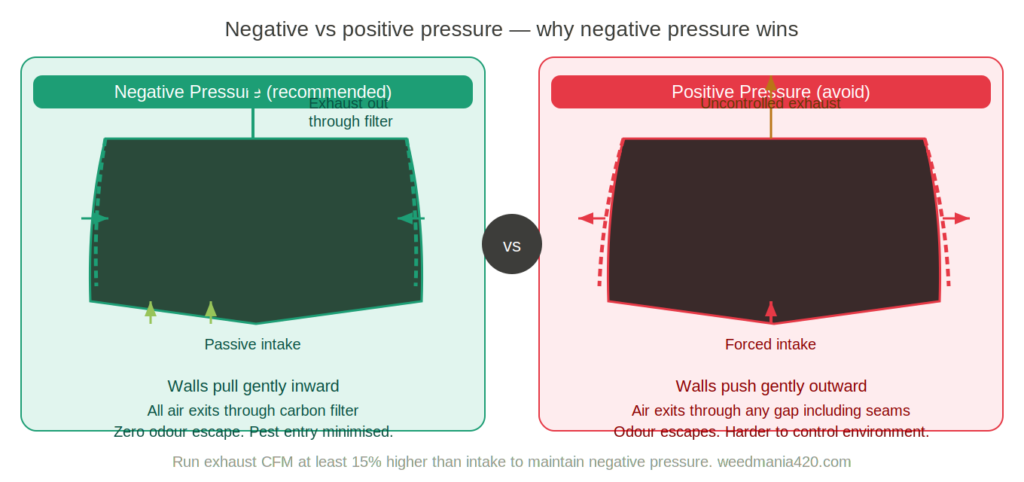
To maintain negative pressure, run your exhaust fan at a CFM at least 15% higher than your intake fan. Most growers use passive intake (open ports without a powered fan) for tents up to 4×4, which naturally creates negative pressure when the exhaust fan runs.
Variables That Change Your CFM Needs
Ambient Room Temperature
A tent in a cool basement needs less CFM than the same tent in a hot attic or spare room in summer. If your room temperature regularly exceeds 80°F (27°C), add another 15 to 20% to your CFM calculation. The fan needs to work harder to maintain a safe canopy temperature.
Growth Stage
Seedlings and young plants in veg produce less heat and transpire less water than a full canopy in late flower. Run your fan at 40 to 50% during the seedling stage and ramp up gradually as the canopy develops. The AC Infinity CLOUDLINE series and similar smart fans can be programmed to maintain minimum speed settings automatically — worth considering for 2×2 tent setups where temperature swings between life stages can be significant.
Number of Plants
More plants means more transpiration — water released from leaves into the tent air as humidity. A tent running four autoflowers in late flower transpires significantly more than the same tent with one plant in early veg. Higher transpiration requires more air exchange to keep humidity in the target range of 40 to 50% during flower.
Ducting Length
For every foot of ducting, add approximately 1% to your required CFM. A 10-foot duct run adds 10% before accounting for bends. Keep runs short, smooth out wrinkles in flexible aluminium ducting, and avoid sharp corners wherever possible.
Recommended Fans by Size
4-inch: AC Infinity CLOUDLINE S4
The most widely recommended 4-inch fan for small grow tents. Quiet EC motor, programmable speed controller, and a CFM rating of up to 205 at max speed. Suitable for 2×2 and 3×3 tents running one LED and one carbon filter. Pairs naturally with any 4-inch carbon filter.
👉 Check current price on Amazon .
6-inch: AC Infinity CLOUDLINE T6
The T6 adds a temperature and humidity sensor to the S6’s programmable speed controller, allowing it to automatically ramp up when the tent gets hot or humid. Rated at 402 CFM at max speed, it suits 4×4 and 4×8 tents comfortably at 50 to 70% speed.
👉 Check current price on Amazon.
8-inch: AC Infinity CLOUDLINE T8
For 5×5 and larger tents, multi-light setups, and growers who want substantial headroom. Rated at 807 CFM max, it handles the most demanding indoor setups while running quietly at low-to-mid speed settings.
👉 Check current price on Amazon.
Air Circulation vs Air Exchange: Two Different Things
Most guides treat ventilation as a single concept. It actually covers two distinct functions that require separate equipment.
Air exchange (what this guide calculates) is the process of pulling stale, hot, humid air out of the tent and replacing it with fresh air from outside. This is handled by your inline fan and ducting system.
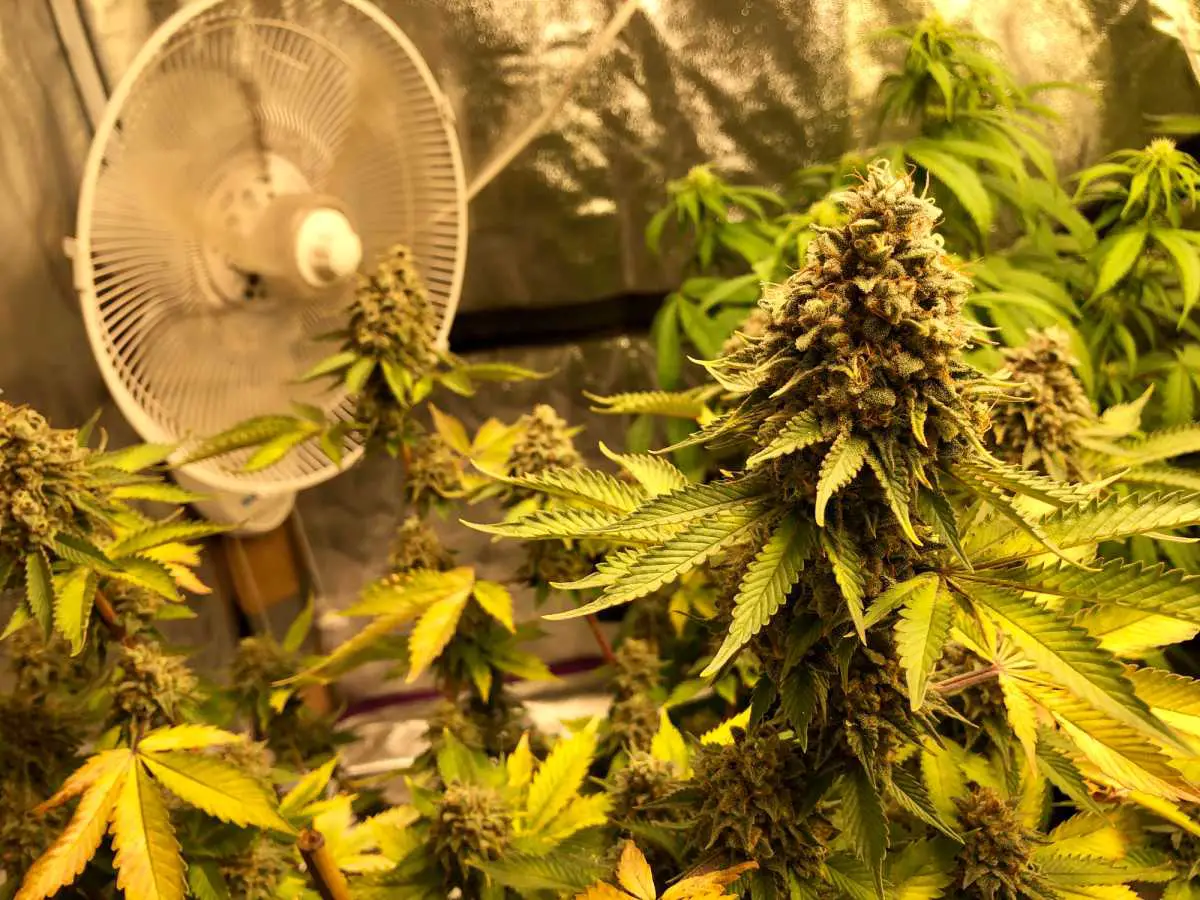
Air circulation is the movement of air within the tent itself — keeping the canopy from developing stagnant hot spots and strengthening stems through gentle airflow. This is handled by a small oscillating clip fan mounted on an internal tent pole, not by the inline fan.
Both are necessary. Sizing your inline fan correctly does not replace the clip fan, and vice versa. In a 2×2 tent setup, a 6-inch clip fan running at low speed circulating air within the tent is as important as the correctly sized inline fan exhausting air out of it.
European Growers: Converting to m³/h
If you are in Germany, the Netherlands, Spain, the Czech Republic, or elsewhere in Europe where fans are rated in m³/h rather than CFM, use this conversion:
m³/h = CFM x 1.699
A 200 CFM fan is equivalent to 340 m³/h. A 400 CFM fan is equivalent to 679 m³/h.
Run the same formula above using metres instead of feet for tent volume, then convert at the end. European grow tent sizes commonly come in 80x80x160cm, 100x100x200cm, and 120x120x200cm configurations.
| EU Tent Size | Volume (m³) | Recommended m³/h | Fan Size |
|---|---|---|---|
| 80x80x160cm | 0.10 | 170-200 m³/h | 100mm (4-inch) |
| 100x100x200cm | 0.20 | 250-300 m³/h | 125mm (5-inch) |
| 120x120x200cm | 0.29 | 350-420 m³/h | 150mm (6-inch) |
| 240x120x200cm | 0.58 | 600-750 m³/h | 200mm (8-inch) |
Common Mistakes
Buying a fan rated at exactly your required CFM. Fan CFM ratings are measured under ideal conditions with no load. In real-world use with a carbon filter and ducting attached, actual airflow drops by 20 to 40% from the rated figure. Always buy above your calculated requirement.
Running the fan at maximum speed continuously. Constant max-speed operation shortens fan lifespan and creates noise that becomes genuinely annoying in a home environment. Size up so you can run at 60 to 70% speed as the normal operating point.
Forgetting to account for ducting bends. A 90-degree bend reduces airflow by up to 60%. Two sharp bends in a duct run can halve the effective airflow reaching the tent, turning a correctly sized fan into an undersized one.
Mismatching fan and filter diameters. A 4-inch fan connected to a 6-inch filter, or vice versa, creates restriction and pressure drop that reduces effectiveness from both. Match diameters throughout the system.
Not checking for light leaks after sealing duct ports. Every sealed duct port and inlet is also a potential light leak point. After setting up and sealing your ventilation system, run the darkness test to confirm no gaps remain.
FAQ
What size fan do I need for a 4×4 grow tent? A 6-inch fan rated at 350 to 450 CFM, run at 60 to 70% speed. The AC Infinity CLOUDLINE T6 (402 CFM) is the most commonly used option for a 4×4 with one LED and one carbon filter.
What size fan for a 2×2 grow tent? A 4-inch fan rated at 150 to 205 CFM. The AC Infinity CLOUDLINE S4 suits most 2×2 setups. See the full 2×2 grow tent setup guide for the complete equipment list.
Does fan size affect smell control? Yes, indirectly. An undersized fan cannot pull sufficient air through the carbon filter, reducing odour elimination effectiveness. See our carbon filter guide for filter sizing to match.
Should I use an intake fan or passive intake? For tents up to 4×4, passive intake through open vent ports is sufficient when the exhaust fan creates adequate negative pressure. Tents above 5×5 or setups with high heat loads benefit from an active intake fan running at 85% of exhaust CFM.
How often should air be exchanged in a grow tent? Once every one to three minutes is the standard recommendation. In hot environments or during peak flower with a full canopy, once per minute is preferable.